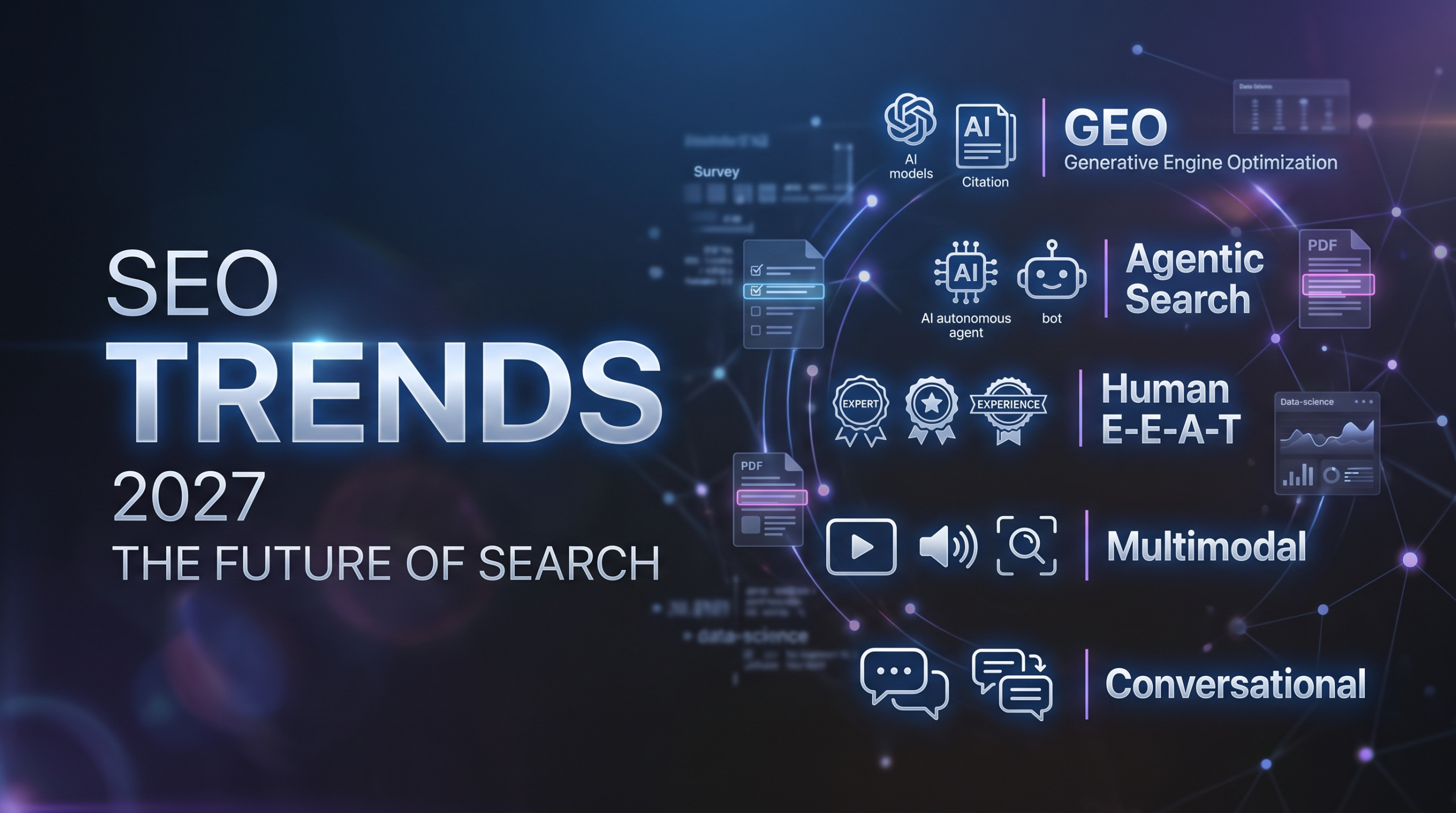
Search engine optimization in 2027 is moving past the legacy paradigm of “ten blue links” and rank tracking, driven by widespread adoption of conversational answer engines, Retrieval-Augmented Generation (RAG), and autonomous AI agents. As Google AI Overviews, OpenAI, Gemini, and Perplexity handle an increasing share of discovery, search optimization is shifting from driving website clicks to securing citations, structured machine readability, and brand influence across large language models.
1. Shift from SERP Rankings to Generative Engine Optimization (GEO)
- Citation Frequency Over Position #1: Appearing at the top of organic results no longer guarantees attention if an AI summary synthesizes the answer above the fold. Success is measured by Brand Share of Model—how frequently and favorably an AI engine cites your brand when answering relevant user queries.
- Answer-First Information Architecture: AI extraction layers discard conversational padding and long narrative intros. Content must use structured, fact-dense “answer blocks” at the top of sections to provide immediate, quote-ready information that RAG pipelines can ingest cleanly.
- Topic Salience Over Exact-Match Keywords: Generative systems evaluate semantic depth and conceptual completeness. Targeting broad topical clusters and addressing associated sub-questions directly replaces repetitive keyword densities.
2. Optimization for Agentic Search and Autonomous Web Actions
- Machine-to-Machine SEO: Search is increasingly conducted by autonomous software agents acting on a user’s behalf to compare software, book reservations, or purchase products. Technical SEO must optimize for bot-driven utility rather than human visual browsing.
- Standardized Machine Endpoints: Adoption of protocols such as structured API endpoints, machine-readable specifications, and curated directories (like
llms.txt) allows AI agents to parse pricing, inventory, and policy terms without tripping over complex visual scripts or paywalls. - Transactional Schema: Rich snippet markup is expanding to include deep action-mapping schema, enabling autonomous agents to execute multi-step workflows (e.g., checkout, booking, scheduling) directly from the answer layer.
3. Proprietary Data and Human E-E-A-T as the Core Competitive Moat
- The Anti-Synthetic Filter: Because generative AI can churn out unlimited generic text, search algorithms aggressively demote commoditized, derivative content. Algorithms rely on strict E-E-A-T (Experience, Expertise, Authoritativeness, and Trustworthiness) signals to verify that advice originates from real practitioners.
- Proprietary Datasets & Original Research: Content containing unique survey numbers, benchmark tests, teardowns, and primary source interviews serves as indispensable ground-truth data that AI models must actively quote rather than paraphrase.
- Off-Page Consensus & Digital PR: Answer engines validate on-page claims through third-party mentions. Sustained discussions across Reddit, specialized forums, YouTube reviews, and accredited journalism provide the external consensus signals AI systems require before surfacing brand recommendations.
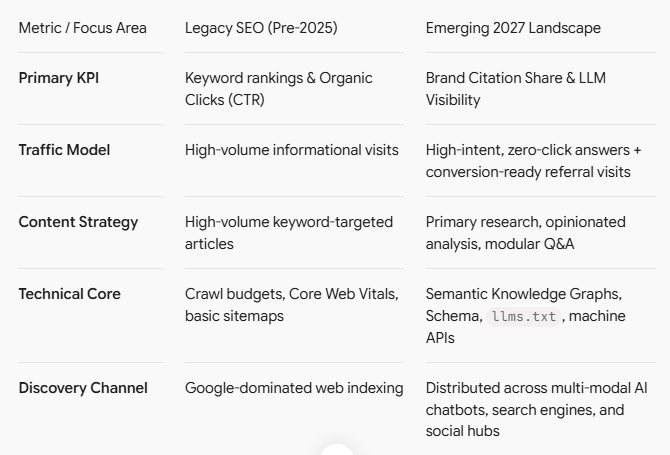
4. Evolution of Search Metrics: 2024 Baseline vs. 2027 Reality
5. Multimodal and Multi-Platform Search Ecosystems
- Cross-Platform Verification Loops: User journeys rarely begin and end on a single search bar. Audiences frequently initiate research via conversational AI, validate the recommendations through user reviews or community forums, and finalize purchasing decisions on video or direct retail hubs.
- Visual & Spoken Search Parity: Optimization extends to conversational transcripts, video chapters, audio podcasts, and annotated diagrams. As multimodal models simultaneously parse audio, image, and text content, brands lacking multimedia coverage miss key ingestion pipelines into generative answer engines.
Which specific segment of your digital strategy—technical machine-readability, brand citation monitoring, or restructuring legacy content for AI extraction—are you looking to adapt first?
Leave a Reply