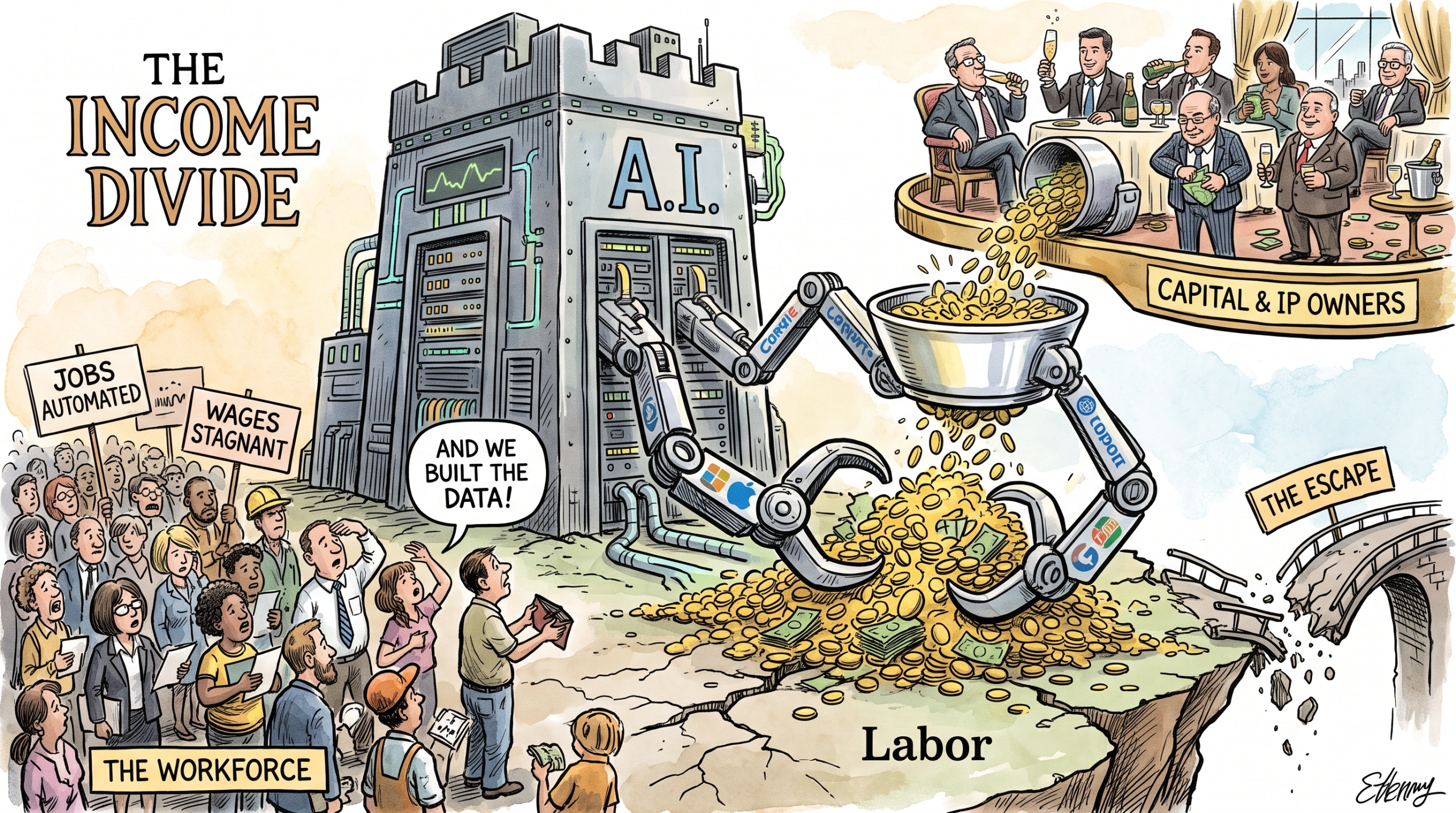
The rapid integration of artificial intelligence across corporate operations is unlocking immense productivity, yet it is simultaneously accelerating one of the most pressing macroeconomic crises of the era: the deepening income and wealth divide. While technological revolutions have historically disrupted labor markets before establishing new employment ecosystems, the speed and cognitive reach of modern AI threaten to decouple economic output from wage growth, concentrating unprecedented returns into the hands of capital owners while compressing labor’s share of national income.
At the foundation of this expanding disparity is the shifting balance between capital and labor. Prior waves of mechanical automation primarily replaced routine manual labor, creating opportunities for cognitive and supervisory roles to expand. Modern generative models and autonomous agents, however, target knowledge work directly—disrupting entry-level software development, paralegal research, financial modeling, copywriting, and customer support. As enterprises deploy AI to perform tasks previously handled by junior white-collar workforces, organizations achieve significant operational efficiencies without expanding payrolls. The resulting gains flow primarily to intellectual property owners, compute providers, and equity holders rather than circulating through broader labor compensation.
This dynamic is accelerating a polarized, two-tier labor structure. Highly specialized professionals who direct complex systems, manage proprietary infrastructure, and interpret model outputs command soaring wage premiums. Conversely, workers in routine cognitive and administrative roles face wage stagnation, reduced bargaining leverage, or displacement into lower-paying service occupations. Because advanced software scales with near-zero marginal cost, multi-billion-dollar tech and enterprise platforms generate massive valuations with a fraction of the workforce traditionally required. This “winner-take-most” dynamic suppresses competitive wage bidding across industries, entrenching market power among a handful of dominant corporate players.
Beyond domestic labor markets, AI is widening economic inequality on a geopolitical scale. Capitalizing on frontier AI requires staggering capital expenditures, specialized semiconductor manufacturing, gigawatt-scale data center infrastructure, and vast clean power capacity. Advanced economies, led by the United States, absorb the overwhelming majority of private AI venture funding and compute hardware. In contrast, developing nations—frequently hindered by limited digital infrastructure and prohibitive connectivity costs—risk severe technological disenfranchisement. Furthermore, as advanced nations automate manufacturing and business process outsourcing, lower-income countries risk losing the comparative labor cost advantages that historically enabled industrial development.
Without deliberate policy intervention, market incentives will continue to concentrate AI-generated wealth at the top. Mitigating this divide demands structural reforms, including modernizing tax frameworks to reduce the preferential treatment of capital over labor, funding continuous workforce transition programs, and strengthening safety nets to insulate populations from sudden technological displacement. The central economic question of the AI era is not whether these technologies can generate immense new wealth, but whether governance institutions can prevent that prosperity from remaining locked within executive suites, server farms, and sovereign compute clusters.
Leave a Reply