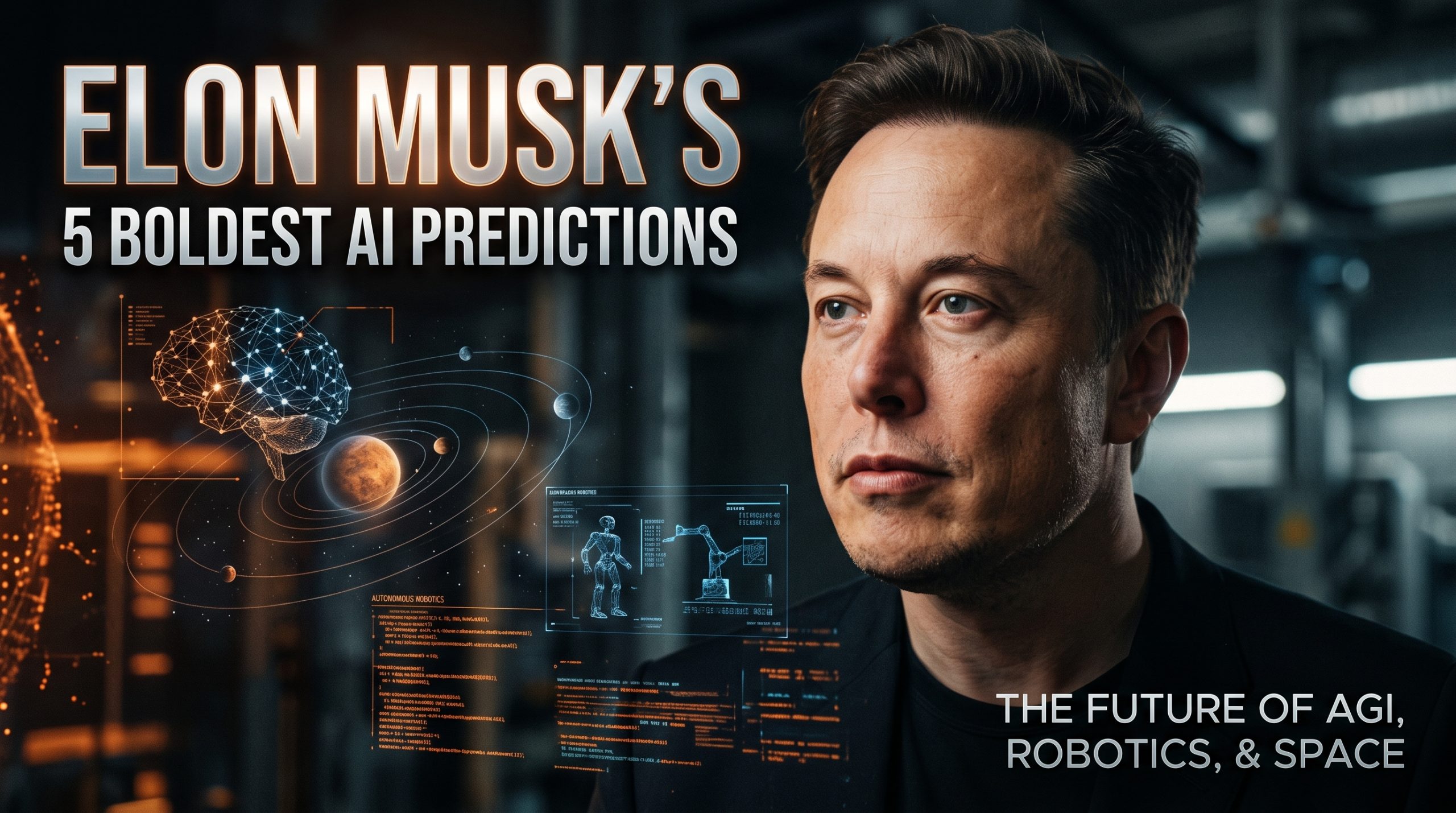
Elon Musk’s timeline for artificial intelligence maps out a rapid acceleration of machine capabilities, pairing highly aggressive technological forecasts with existential warnings. His public statements present a future where software transcends human ability within years, though his historical track record of delayed product launches often invites heavy scrutiny from the tech industry
1. Human Intelligence Surpassed by 2026
- Musk predicts that artificial general intelligence (AGI) will emerge rapidly, stating at the World Economic Forum in early 2026 that AI would surpass the intelligence of any single human by the end of that year.
- This deadline was a slight shift from a previous public claim that originally targeted 2025 for AGI.
- Looking further ahead, he told The Economist in mid-2026 that AI could exceed the combined sum of all human intelligence by roughly 2031.
2. Superhuman Competence in Digital Tasks by 2027
- Beyond a generalized measure of intelligence, Musk forecast in late 2026 that AI could perform nearly any digital task at a superhuman level by the end of 2027.
- This means systems would not just act as brief assistants, but consistently outperform elite experts across fields like coding, research, financial analysis, and legal review over an entire working day.
- He makes a firm distinction between digital labor and physical robotics, arguing that software-based work will be automated much faster because it does not require physically shaping or moving real-world objects.
3. The Relocation of AI Infrastructure to Space
- Addressing the immense electrical requirements of advanced computing, Musk predicts that the lowest-cost environment for deploying AI will eventually be in space.
- He expects this transition to occur within two to three years.
- This shift is driven by the fact that space-based solar panels operate at five times the efficiency of earthly ones due to continuous sunlight and zero atmospheric interference.
4. The Mainstreaming of Humanoid Robotics
- Musk ties his AI software predictions directly to physical automation, projecting that Tesla’s Optimus robot will be available for public sale by late 2027.
- He estimates that initial production will be extremely slow, but he envisions scaling up to produce one million humanoid robots annually within five years.
- He envisions a future where billions of AI-driven robots eventually outnumber humans and fulfill all human needs, which he believes will trigger unprecedented global economic growth.
5. A 20% Chance of Global Catastrophe
- Despite driving rapid development at xAI and Tesla, Musk maintains that superintelligence poses a significant threat to humanity without proper guardrails.
- He consistently estimates a 10% to 20% probability that advanced AI could lead to catastrophic outcomes or even the end of humanity.
- Despite these dire warnings, he advocates for maximizing the likelihood of a good future by extending consciousness beyond Earth, noting that he believes humans might be the only conscious life forms in the universe.
These forecasts highlight a deep paradox in Musk’s worldview. He simultaneously warns that humans may lose control of AI within a decade while aggressively pushing the very boundaries of the technology he fears. Critics frequently point out that his past predictions for fully autonomous driving and robotaxi launches have been repeatedly delayed over the past decade, suggesting these new timelines may also slip. Whether his aggressive benchmarks materialize precisely on time or not, his predictions continue to anchor the global debate over how quickly the labor market and society must prepare for artificial superintelligence.
Leave a Reply