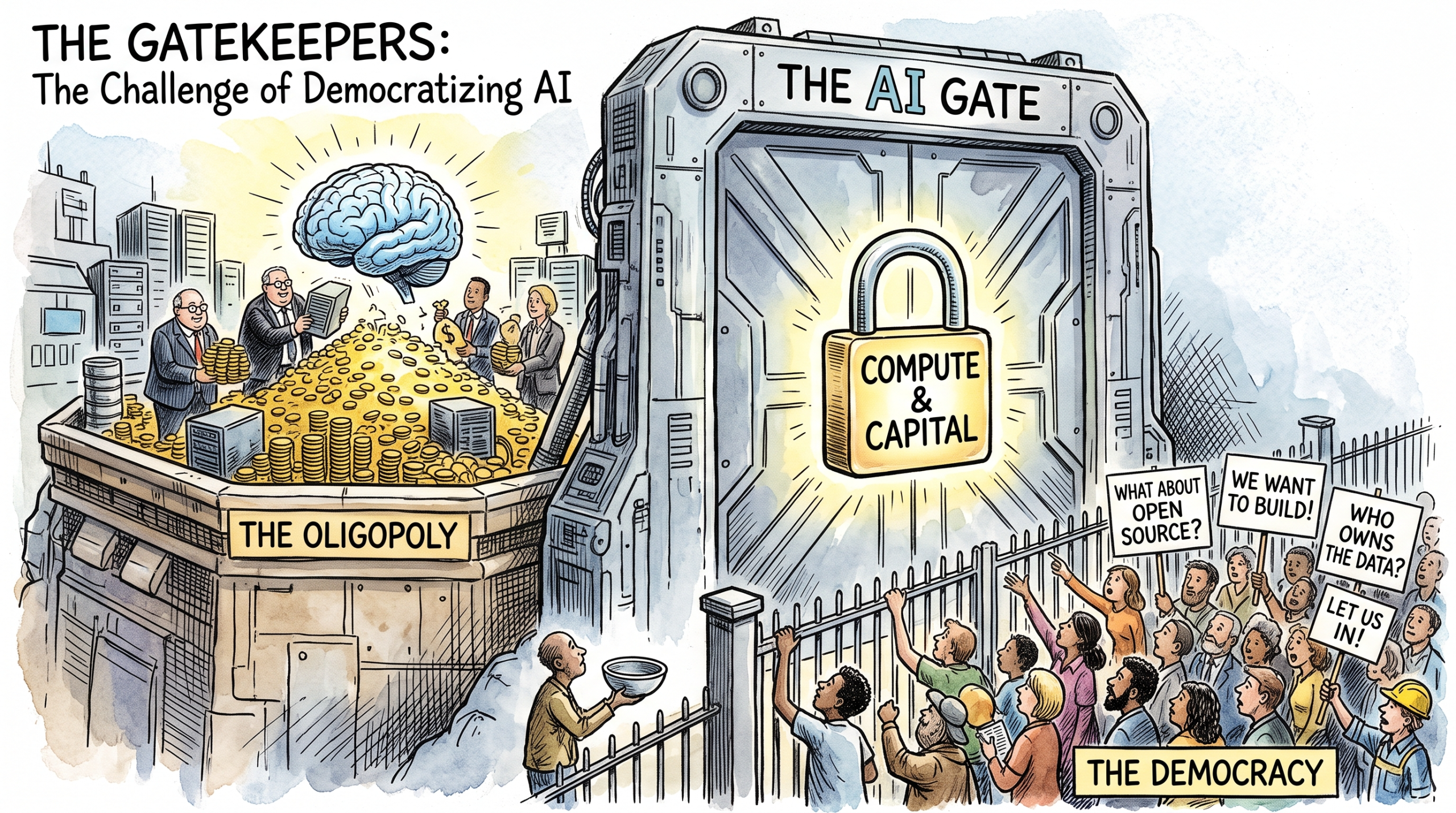
The promise of “democratizing AI” has become one of Silicon Valley’s most ubiquitous marketing anthems. Corporate press releases routinely claim that releasing chat interfaces, open APIs, and browser plugins puts the power of artificial intelligence into the hands of ordinary citizens and small businesses.
Yet this narrative conflates consumer access with democratic empowerment. Providing millions of users with a conversational text box does not democratize artificial intelligence any more than handing out television sets democratized the broadcast media industry. Beneath the user-friendly interfaces lies an unprecedented concentration of capital, hardware, and geopolitical leverage that makes artificial intelligence one of the most centralized technologies in modern history.
The Capital Moat: Compute, Energy, and Silicon
True democratization requires that the means of production—not just the final outputs—be accessible. In modern frontier AI, the barriers to entry at the foundation layer have grown prohibitively steep.
- Capital Expenditures: Training a state-of-the-art foundation model requires multi-billion-dollar investments in cutting-edge semiconductor clusters, specialized liquid-cooling facilities, and massive high-bandwidth networking fabric.
- Energy Infrastructure: Next-generation AI training clusters demand hundreds of megawatts—and increasingly gigawatts—of dedicated electrical power. Big Tech hyperscalers are securing private nuclear power contracts and constructing dedicated electrical substations that sovereign states often struggle to finance, let alone academic institutions or independent startups.
- Hardware Oligopolies: The cutting-edge hardware stack remains tightly bottlenecked across a fragile, highly consolidated supply chain, from lithography equipment to specialized high-bandwidth memory (HBM).
When only a half-dozen multinational conglomerates have the balance sheet to train a state-of-the-art model from scratch, the underlying intelligence layer of the global economy becomes a private utility governed by corporate boards rather than the public good.
Interface Access vs. Systemic Agency
The current model of democratization is fundamentally a rentier economy. Small businesses, developers, and researchers are encouraged to build workflows on top of proprietary foundation models via subscription tiers and pay-per-token APIs.
This creates systemic vulnerabilities for downstream users:
- Sovereignty & De-platforming: Applications built on proprietary APIs are vulnerable to sudden changes in pricing, usage policies, or latency. An enterprise or independent developer building their core workflow on a proprietary model possesses zero operational leverage if the provider alters its terms or deprecates an endpoint.
- Data Extraction Loops: Every prompt, query, and fine-tuning dataset fed into hosted proprietary systems risks contributing to the telemetry and training flywheel of the platform owners, turning early adopters into unpaid data contributors.
- Algorithmic Black Boxes: Proprietary models operate with opaque alignment filters and undocumented system prompts. Users cannot audit the underlying safety guardrails, political guardrails, or training distributions that govern how the model interprets requests.
Regulatory Capture and the Open-Source Battleground
Open-weights models—such as Meta’s Llama family, Mistral, and open-source models emerging from global research hubs—represent the most direct counterweight to corporate enclosure. They allow universities, regional governments, and small developers to run, modify, and host models locally on private infrastructure.
However, the proliferation of open-source AI faces sustained institutional pressure:
- Safety Licensing as a Moat: Dominant proprietary players frequently advocate for heavy regulatory licensing frameworks, arguing that releasing model weights publicly poses catastrophic biosecurity or cyberwarfare risks. While AI safety concerns are real, restrictive compliance regimes risk functioning as anti-competitive moats, pricing out open-source alternatives and independent researchers who lack compliance departments.
- Asymmetric Compute Scaling: While open-source communities excel at fine-tuning, quantization, and architectural efficiency (such as small language models capable of running on consumer laptops), the foundational reasoning leaps continue to be driven by massive, centralized compute runs that open-source consortia cannot easily finance.
Cultural Monopolies and Epistemic Hegemony
Democratization is also a matter of cultural and epistemic representation. Large foundation models are trained predominantly on digital content generated in the Global North, heavily skewed toward English-language internet corpora and Western legal, cultural, and political assumptions.
When these models are exported globally as default cognitive infrastructure for education, governance, and enterprise productivity, they import distinct normative assumptions. Developing nations and marginalized language groups face a stark choice: adopt proprietary Western models that flatten their cultural nuances, or operate without frontier AI capabilities because building indigenous foundation models from scratch is financially out of reach.
What Genuine Democratization Requires
If artificial intelligence is to be genuinely democratized rather than rented out as an enterprise subscription, structural interventions are essential:
- Public Compute Infrastructure: Establishing federally funded, publicly governed compute utilities (such as national AI research clouds) that grant academic institutions, civic organizations, and independent researchers free access to frontier-scale training hardware.
- Protection of Open-Weights Development: Ensuring AI safety legislation differentiates between proprietary deployment platforms and open-source scientific research, preventing regulatory frameworks from criminalizing open code.
- Decentralized Architectures & Edge AI: Prioritizing research into efficient architectures, federated learning, and on-device inference, allowing high-performance reasoning to occur on decentralized hardware without perpetual reliance on centralized server farms.
Until society addresses who owns the silicon, who powers the data centers, and who controls the underlying model weights, the “democratization of AI” will remain a cosmetic feature of a deeply centralized economic system.
Would you like to explore a policy-focused follow-up on how public compute utilities (like the National AI Research Resource) are structured, or generate an accompanying 16:9 editorial cover image for this article?
Leave a Reply