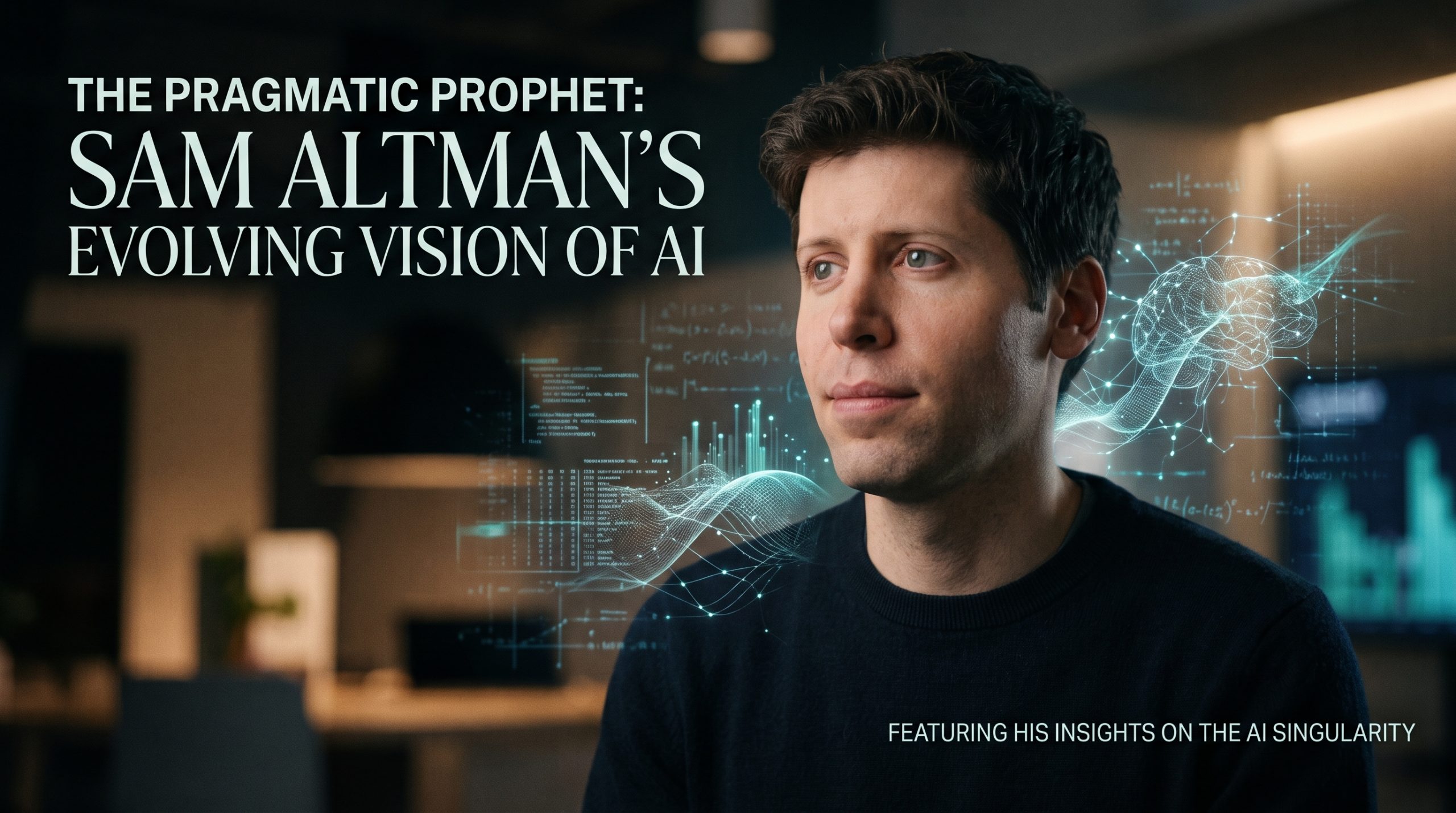
As the CEO of OpenAI, Sam Altman has arguably become the definitive voice of the artificial intelligence revolution. Over the years, his thoughts on AI have transitioned from speculative philosophy to bold, present-day declarations, reflecting the rapid pace of the technology his company develops. Today, Altman’s worldview is characterized by a firm belief in an impending era of unprecedented abundance, tempered by a controversial pragmatism regarding the costs of getting there.
At the core of Altman’s current thesis is the belief that humanity has crossed a historic threshold. In mid-2026, he bluntly declared that we have entered the “AI singularity”—a period marked by compounding, self-reinforcing technological progress. Altman refers to this as a “gentle singularity,” describing a world in which the “takeoff has started” and where current models are merely a “larval version of recursive self-improvement”. To Altman, this signifies a fundamental shift where scientific breakthroughs will become routine, driven by machines capable of executing complex digital tasks with increasing autonomy.
This vision represents a maturation of ideas Altman has held for over a decade. In a 2014 reflection, he speculated that advanced AI might lead to a natural division of labor where “computers get really good at doing, and humans get really good at thinking”. While he once questioned how machines could ever be taught to independently care about creative pursuits, he acknowledged that machine creativity might eventually emerge in non-intuitive ways. Fast-forward to the present, and OpenAI’s models are increasingly blurring the lines between human and machine capabilities, validating his early predictions about artificial intelligence mastering complex tasks.
However, Altman’s steadfast push toward this future is not without significant friction. His philosophy is rooted in the conviction that the astronomical benefits of AI will vastly outweigh its negatives. Recently, this utilitarian calculus has drawn intense public scrutiny. In late 2026, Altman argued that society must be willing to accept “some bad things happening” as a necessary trade-off for AI’s enormous societal benefits. This rhetoric has sparked immediate backlash from critics and public officials, who argue that tech executives should not unilaterally decide the acceptable collateral damage of their products.
Compounding these ethical concerns are structural shifts within OpenAI itself, such as reports of moving toward a for-profit model and engaging in classified contracts with the military. For detractors, these moves contradict the company’s original non-profit mission to ensure AI benefits all of humanity, casting Altman’s optimistic foresight in a more corporate light.
Ultimately, Sam Altman’s thoughts on AI represent a profound paradox. He is an unabashed technological optimist who genuinely believes that AI will usher in a golden age of human prosperity. Yet, he is also a pragmatic executive willing to navigate the immediate societal disruptions his technology causes. As we navigate the singularity he described, Altman’s philosophy continues to shape not only the code behind our most advanced machines, but the moral framework of our shared digital future.
Leave a Reply